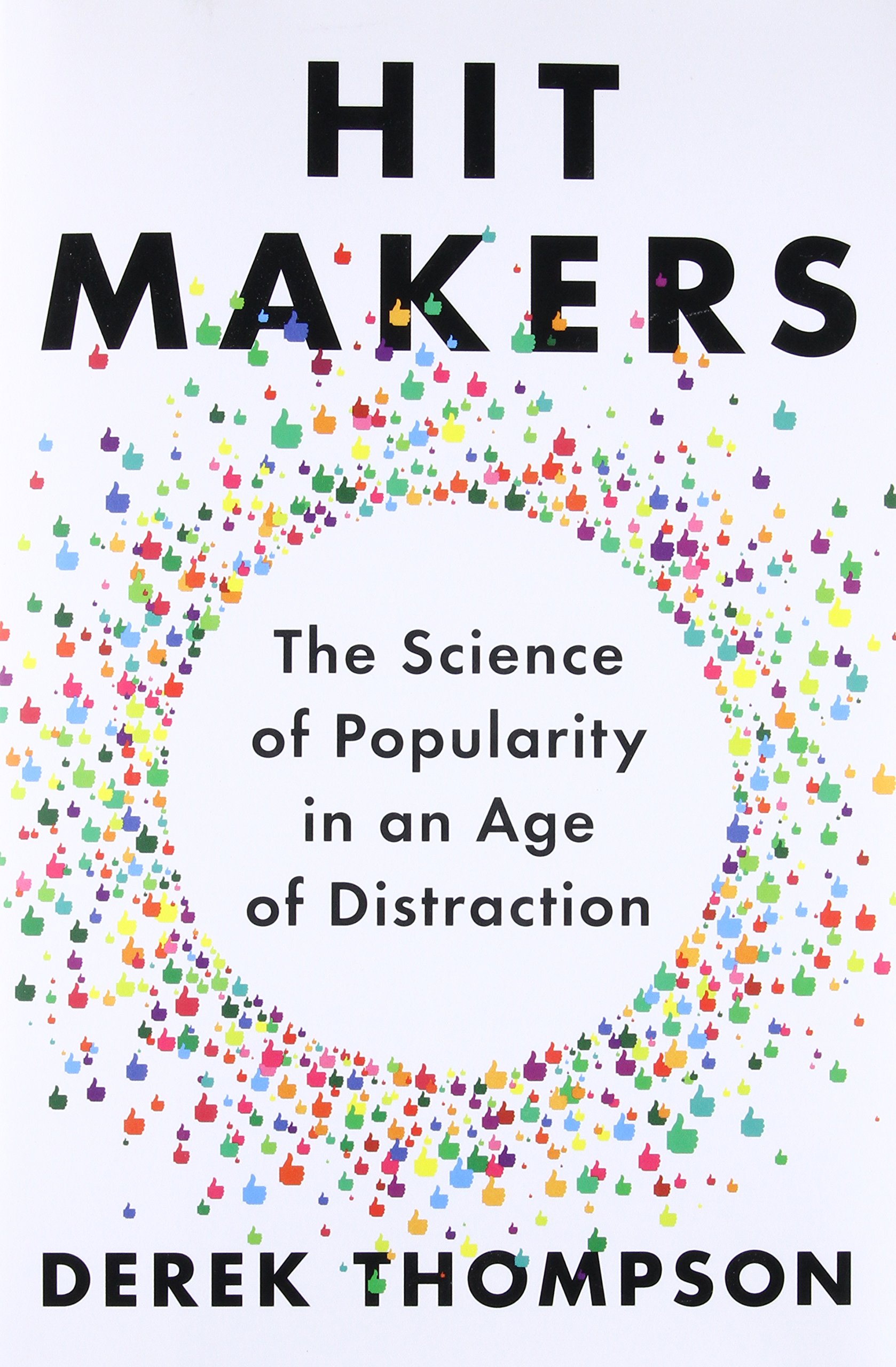
Hit Makers

Hit Maker takes an in-depth look at what makes a viral or popular product. In this book, Thompson provides detailed research on the key factors that cause content and products to become popular. Thompson argues that the products that become popular are a balance of familiarity and newness. He cited Raymond Loewy, the industrial designer, whose approach was summed up in his acronym MAYA “the Most Advanced Yet Acceptable” idea. This theory explains that people are simultaneously Neophobic, afraid of the new, and Neophilic, attracted to the new. In order for a new idea, content or product, to be popular, it must balance this tension. It is not the most innovative or advanced products that become sought but those that blend acceptability with innovation.  He also argues that there is a need for newness, as there is a danger in too much familiarity or too much of the same content which leads to a sharp fall in popularity. There must be a balance between newness and innovation.

Derek Thompson believes that familiar ideas or content leads to more liking of the content. He quotes an interesting study where people were asked to either name two things they liked about their partner or ten things they liked. The study found that people liked their partner more if they are asked to name just two things they liked. When asked to name ten things, it became harder and they rated their partners lower after the exercise. He uses many examples where companies use familiarity, including movies. Because we like familiarity, a key ingredient of popularity is repeated exposure. Most of the top revenue grossing movies of the last ten years have been based on popular novels. There is safety and familiarity in such movies. Also, car manufacturers blend familiarity with newness by changing a car’s style every few years. Derek Thompson also explores products that manage to make it big through the combination of timing, weird circumstances and savvy use of repetition while their pairs never made a splash. After reaching a tipping point, customers do not just buy a product but the popular conversion. A great example of this is Apple products. It is no secret that Apple has somehow lost its magic when it comes to disrupting markets through innovative products and yet, it became the first American company to surpass a trillion dollar value as I write this Bite.  No one wants to be the last to read or watch so they buy to participate in the conversion.

One of my favorite sections of the book is on the power of creating popular phrases. It talks about the power of repetition. Through Thompson's lens, repetition can explain anything that is popular. He argues that human beings love music because of our love for repetition. Repetition, he says, is the God particle of music.

Hit Makers is full of “aesthetic aha”. This is a term for the moment when you look at something and for the first time, you understand and everything just clicks and comes together. The moment when you read an essay’s thesis and feel that it’s expressing something you’ve thought of before but never had the chance to put into words. It is that moment when your eyes light up because something clicked and was understood in your brain, the "aha moment." It is beyond the feeling that something is familiar. It’s when something new, challenging or surprising that opens a door into a feeling of comfort, meaning or familiarity.

THE BIG THREE - KEY POINTS

Key point #1: Popularity will always be found in the balance between familiarity and newness.

Key point #2: Repetition is key in creating popular and viral phrases.

Key point #3: It is not the most innovative or advanced products that become sought after but those that blend acceptability with innovation.

One Last Thing

“A new scientific truth does not triumph by convincing its opponents and making them see the light, but rather because its opponents eventually die, and a new generation grows up that is familiar with it.”

― Derek Thompson, Hit Makers: Why Things Become Popular
The Innovation Secrets of Steve Jobs

Carmine Gallo is a communication skills coach who works with leading companies like Intel, IBM, Chase, The Home Depot, Bank of America and others. He is the founder of Gallo Communications, a consulting firm.

In this book, Gallo talks about fundamental principles that allowed Steve Jobs to innovate brilliantly constantly. This book offers seven general principles that Steve Jobs applied to achieve genuine breakthrough success.

PRINCIPLE #1 - DO WHAT YOU LOVE: Passion is everything. Innovation is a new way of doing things that improves our lives. Innovation cannot flourish unless you are truly obsessed with making something better, be it a product, service or career. Steve Jobs says “have the courage to follow your heart and intuition. They somehow already know what you truly want to become.” Steve chooses to follow his heart through his entire career and that passion, he says, has made all the difference. It is difficult to come up with new and creative ideas that move society forward if you are not passionate about the subject.

PRINCIPLE #2 - PUT A DENT IN THE UNIVERSE: Aspire to change the world. Innovation does not take place in a vacuum. You need to know what your ultimate destination is and you need to inspire others. Steve Jobs never underestimated the power of vision to move a brand forward. He set out with a vision to change the world and he pushed through with his vision. What is your vision for your product, brand or career? If there is one fundamental characteristic that every innovator has, it is seeing things not for what they are, but for what they could be. The famous Steve Jobs’ quote of putting a dent in the universe refers to having a vision of creating what was not there before. To innovate, you have to be able to see it before anyone else does.

PRINCIPLE #3 - KICKSTART YOUR BRAIN: This appeals to creativity. Creativity leads to innovative ideas. Job believes that a broad set of experiences expands your understanding of the human experience. A more comprehensive understanding leads to breakthrough that others may have missed. Breakthrough innovation requires creativity and creativity requires that you think differently about the way you think. Steve jobs say “creativity is just connecting things.” Steve Jobs created new ideas because he spent a lifetime exploring new and unrelated things. Look outside your industry for inspiration.

PRINCIPLE #4 - SELL DREAMS NOT PRODUCTS:  Your customers don’t care about your product, your brand or your company. They care about themselves, their dreams, hopes and ambitions. To win them over, you have to help them fulfill their dreams. A lot of times, people think they are crazy, but in that craziness we see genius.

PRINCIPLE #5 - SAY NO TO UNNECESSARY: Steve Jobs says “Innovation comes from saying NO to one thousand things to make sure we don’t get on the wrong track or try to do too much.” Jonathan Ive, Apple design guru says: “We are absolutely consumed by trying to develop a solution that is very simple because as physical beings, we understand clarity.” Customers demand simplicity, and that requires you to eliminate anything that clutters the user’s experience.

PRINCIPLE #6 - CREATE AN INSANELY GREAT EXPERIENCE: Don’t move product, instead enrich lives and watch your sales soar. People don’t want products, or even services for that matter. They want to know what they can do with them. Jobs has made the Apple store the gold standard in customer service by introducing genuine innovation that any business can adapt to create a deeper more emotional connection with their customer. For instance, in an Apple store, there are consultants, experts and even geniuses,  but no cashier. Tony Hsieh, Zappos CEO said, “ if you just think about what makes customers and employees happy, in today's world, that ends up being good for business as a whole." As leaders, we are called to design a working environment in which our teams can feel themselves and be creative. Design an insanely great experience for the customers and equally for the staff members.

PRINCIPLE #7 - MASTER DELIVERING THE MESSAGE: You can have the most unique idea in the world, but if people can’t get excited about it, it doesn’t matter. Steve Jobs is considered the greatest corporate storytellers worldwide because his presentations inform, educate and entertain. There are no bullet points in Steve Jobs presentations. Instead, he thinks visually and iconically; therefore everything he touched was iconic:  Apple, Pixar, iPod, iPhone, iPad, iMac and himself.

Innovation takes confidence, boldness  and discipline to tune out negative voices. As Jobs said, “Don’t let the noise of others opinions drown out your inner voice.”

THE BIG THREE - KEY POINTS

Key point #1: Design amusement parks for the mind where staff members and the customer can live an excellent experience. Capture those experiences in processes and innovation will flow.

Key point #2: Innovation is for people that sound crazy. The thing about smart people is they sound crazy to dumb people. Surround yourself with crazy.

Key point #3: Never underestimate the power of vision to move a brand forward.


One Last Thing

"When you grow up you tend to get told the world is the way it is and your life is just to live your life inside the world. Try not to bash into the walls too much. Try to have a nice family, have fun, save a little money.”  That's a very limited life.

Life can be much broader once you discover one simple fact: Everything around you that you call life was made up by people that were no smarter than you and you can change it, you can influence it, you can build your own things that other people can use.

Once you learn that, you'll never be the same again."  ~ Steve Jobs

The Presentation Secrets of Steve Jobs

The Presentation Secrets of Steve Jobs covers everything from the basics of presenting, including structure and concepts on slide design, to scripting and the detailed dress rehearsals that set Jobs’ success apart from others. Steve Jobs was always eager and hungry to learn, advance and excel. His philosophy was to do what you love, view setbacks as opportunities and dedicate yourself to the passionate pursuit of excellence. The author, Carmine Gallo, does an excellent job dividing the book into three sections he calls acts. The first act is about creating the story that you want to deliver in the presentation. The second act is all about the stage; how to not lecture but rather give an extraordinary experience on the stage. The third act is about refining and becoming better. Let’s take a deep look  into each act:

ACT 1 - CREATE THE STORY

Develop a messianic sense of purpose. Jobs has been giving astounding and inspiring presentations for decades. A very famous one was during the unveiling of the first Macintosh in 1984.  From the stage, before the entire room goes totally dark, he says, “You have seen some pictures of Macintosh, now I want to show you Macintosh in person. All of the images that you're about to see on the large screen will be generated by what is in that bag."  What happens next is a crowd applauding and cheering every step of the way. Without saying a word, Jobs shows how easy it was to take the Macintosh out of the bag and how the entire presentation fit in a packet through a floppy disk. The audience laughed and applaud. For the first time, the world saw a computer with multiple fonts, the ability to play chess and serve as a calculator. He walked back to the microphone and delivered his final pitch, "Now, we’ve done a lot of talking about Macintosh recently, but today for the first time ever, I’d like to let Macintosh speak for itself."  He walked back to the computer and the big screen displayed the words "Hello, I am Macintosh. It sure is great to get out of that bag..." The computer then cleverly “throws a punch” at IBM by saying "Never trust a computer you can’t lift." The crowd couldn't get enough of it, applauding and cheering. Probably one of the most exciting four minutes of any product launch presentations ever made. Yes, Steve and his Macintosh delivered the messianic message that "from this point on, COMPUTERS ARE PERSONAL!”

Even now, that launch remains one of the most dramatic presentations in corporate history.

Below is the link for your enjoyment. It’s worth the watch!

https://www.youtube.com/watch?v=8bepzUM1x3w

Do what you love. This has been Steve Jobs’ secret to success. He says, “ You’ve got to find what you love, going to bed at night saying I have done something wonderful, that’s what mattered.” He was inspired by a purpose beyond making money. Jim Collins says some managers are uncomfortable with expressing emotions about their dreams, but it’s passion that will attract and motivate others.

  • Plan in Analog: the most important thing you can do to improve your presentation dramatically is to have a story to tell before working on your powerpoint. Genuinely great presenters like Steve Jobs visualize, plan and create ideas on paper or whiteboards well before they open their PowerPoint software. Nancy Duarte recommends that a presenter spend 90 hours on 30 slides. But only one-third of the time is spent building slides. Another third rehearsing, but the first third is spent collecting ideas, organizing ideas and selecting story.
  •   Create Twitter-like Headlines.
  •   Stick to the rule of 3: Create the story, deliver an experience, refine and rehearse.
  •   Introduce the antagonist.

ACT 2 - DELIVER THE EXPERIENCE

  •  Eliminate clutter: Steve Jobs made it clear by saying simplicity is the ultimate sophistication. He spent more time taking things out of the slides. In his view, an image, a single word or a simple sentence was more than enough to be used as a visual aid.
  •  Reveal a “holy shit” moment: People will forget what you said, but they will never forget how you made them feel. Create an emotionally charged event ahead of time. Identify the one thing that you want your audience to remember and talk about long after your presentation is over. For Steve Jobs, this became his trademark, "One More Thing..." He used it at the end of every presentation. It was his HOLY SHIT moment that many looked forward to. FaceTime and iTV (AppleTV) were both originally introduced as the “One More Thing.”

Note: If you haven't yet noticed, every Bite has a section called “One Last Thing.” It was inspired by the desire to create one final “Holy Shit” moment for the reader, leaving him or her pondering the message or argument.

ACT 3-REFINE AND REHEARSE

  • Master Stage Presence: Steve Jobs has a commanding presence. His voice, gestures and body language communicate authority, confidence, and energy. He maintains eye contact, open posture and hand gestures with the audience. Body language delivery, all are very important. Cisco researched and found that the body language and vocal tone account for about 63% of communication. You can only improve your body language and vocal delivery when you practice.
  • Wear appropriate costume: Steve Jobs is the anti-Cher. When you invent revolutionary computers, music players and smartphones, your audience will give you permission to dress any way you want.
  • Have fun: Don’t lose sight of the fact that the audience wants to be informed and entertained. Each of Jobs’ presentations is “infortainment.” He teaches his audience something new, reveals new products and has fun doing it.

Steve Jobs said, “Your time is limited, so don’t waste it living someone else’s life. Don’t be trapped by dogma — which is living with the results of other people’s thinking. Don’t let the noise of others’ opinions drown out your own inner voice. Stay hungry. Stay foolish.”


THE BIG THREE - KEY POINTS

Key point #1: People will forget what you said, but they will never forget how you made them feel. Infortain your audience!

Key point #2: Plan and deliver a “Holy Shit” moment. This is as critical as the presentation itself.

Key point #3: Presentation principles are not limited to the stage, a document or a product. A conversation can benefit from the same principles as long as you want to be unforgettable.


One Last Thing

“People would confront a problem by creating a presentation. I wanted them to engage, to hash things out at the table, rather than show a bunch of slides. People who know what they’re talking about don’t need PowerPoint.” Steve Jobs, Biography by Walter Isaacson

How to be a Productivity Ninja

Graham Alcott discovered the low level of productivity caused by information overload in the twenty-first-century workers; therefore he took a deep dive into his book, how to be a productivity Ninja where he shows how to worry less, achieve more and love what you do. In this book, Graham combines all his teachings from his public productivity workshop from all over the world into a simple and practical guide to working faster and smarter.

The goal of this book is to teach you how to overcome procrastination, how to use email more effectively, and new ways to increase your personal time and how to de-clutter an information overload.

Graham identifies stress as one of the critical components for procrastination, within the first chapter he goes into details on how stress agent is created and our ability to deal with them. The author identifies several causes of stress agent among which he listed conflict, overload panic, fear of being foolish among others. He continues by highlighting the aspects of developing a mindset of a Ninja to use in your productivity. This is about living in the present moment and not thinking about what you need to do or worrying about tomorrow. People’s best work happens when they are present and live in the moment.

One of the key components of the book is attention management. We often read about how important our time is, but attention is finite and should be used as a precious resource more than our time, at the end of the daytime alone has no real value, it is the action in time what gives value to time. He went further to state that the key to productivity and ultimately the application of this precious resource will determine your success. He developed an equation to back up his point which is:

TIME + THE RIGHT ATTENTION AND FOCUS = DONE

He categorizes attention as follows:

  •    ACTIVE: Ticking along but flagging a little
  •    PROACTIVE: Fully focused and alert
  •    INACTIVE: Light is on but no one at home

The author also proposed several strategies to maximize periods of proactivity. This includes taking yourself away from distraction and improving concentration then use mechanism for managing task and determining what to do at any given time. Graham proposed the CORD Model.  CORD is an acronym that stands for Capture, Organise, Review and Do. The first two C and O requires for you to operate in ‘BOSS mode’ while the last two will be R & D needs to perform in “worker mode.”

CAPTURE: means collecting ideas and new tasks quickly and efficiently. This allows you to take distraction out of the way soon and get back to the task at hand.

ORGANISE deals with the appropriate filing of the collected task. The task to be organized in lists and give a sense of scales; therefore activities spanning months are not mixed in with tasks requiring minutes. The goal of this model is to ensure that when operating in execute mode, we are clear on what needs to be done and what is committed to at the moment of executing.

REVIEW:  The review process is a formal and regular look across the tasks to be done taking all things into account like context, priorities, what is needed, waiting for items, etc. after the review is complete, the next step is doing.

DO: Graham outlines an excellent separation between the worker and boss views when he explains the different dashboards that are available to each.  The dashboard contents for each are the followings:

Boss mode:

  • Waiting  for list
  •  Masters action
  •  Calendar
  •  Good idealist

Worker mode:

  •    Master Action List
  •    Calendar
  •    Daily list

THE BIG THREE - KEYPOINTS

Key point #1: Say NO to as many distractions as possible

Key point #2: Knowing what tools to use but being clear about what the tools are will save you time and not provide distractions.

Key point #3: Have good systems to help you react and respond quickly.

One Last Thing

A productivity ninja is not a superhero, but they often do a great job in appear so. Graham Alcott, Productivity Ninja

LEAN B2B: Build Products Businesses wants

Lean B2B is a book that was birthed out of several business successes and failures. A little story about why the author wrote Lean B2B. Garbugli, alongside his ex-business partner, decided to start a business that would eventually become HireVoice, a platform to help the industry understand how the market perceives them as employers (employer brand monitoring). At first, there was a series of positive feedback but after the first few modules failed to capture the engagement with the prospects, they discovered that employer brand perception was not enough of a critical problem for companies to pay for their solution. In the end, they failed to build a sustainable business but succeeded in in-validating a startup. It was a successful validation with an adverse outcome. It took Garbugli and his business partner six months to in-validate their first two products, but only three months to invalidate the last three. Garbugli says “Inappropriate B2B customer development cost us four months of runaway and therefore Lean B2B is written to help entrepreneurs save those four months.”

Lean B2B (business to business) is not business a management or product development book. It’s a book about discovering problems that matter and being efficient as possible when going from idea to product-market. The goal of any startup is not to be a startup. A startup is a temporary organization designed to find a reputable and scalable business model. An entrepreneur who is willing to dig deep into the value chain and the into needs of the enterprise will find opportunities for breakout products. They just need the patience and product to see a chance to enter the market. B2B markets are generally much smaller compare to B2Cs. Burning leads in B2C might not be a big deal if the market has millions of potential customers but, with the substantially small market in B2B, burning leads quickly becomes a big deal. To succeed in B2B, entrepreneurs need to build deep relationships with a relatively small number of companies.

Where does it start? The only thing that matters in the first 12-18 months of a company is figuring out how to get your products into the hands of the right people. You have to identify the customers you would like to sell to. The ideal customer is an organization who matches, at a minimum, two of the following criteria:

  1. Has a problem
  2. Is aware of the existence of the problem
  3. Has already tried to solve the problem and failed to address it
  1. Is not happy with the current solution to the problem
  2. Has a budget to get the problem fixed

When you are a startup, client development is the most vital activity you can do. You can develop a product, raise capital, hire a team and incorporate your business but if your product assumption doesn’t match the market needs, you’ll eventually regret having done any of those things. Your startup process will depend on your ability to be laser-focused on finding the ideal product for the right market and not burning all the money in the process. Analytics, responsive design, domain name, branding, press, etc. are not keys to your success. Without the product that people want, the perfect press release or analytic set up will never matter. Forget about vanity metrics and think small. You need to focus on P-M fit (Product-Market fit). This is when you have five passionate customers. The temptation will be strong to start optimizing and building sales channel before reaching P-M fit but resist it. Don’t build a company before you reach P-M fit. Keep your burn low.

In my professional life, I have started dozens of organizations, some with excellent results, others not so much. In the process I have read many books on startups and entrepreneurship. Lean B2B is one of the most practical and closest to real-life experience you can find. This book teaches how to build credibility with prospects, put your products into the hands of early adopters, conduct problem interviews, prioritize problems and opportunities, build an MVP, prepare a pitch, conduct solution interviews, assess whether you have found product-market fit and techniques to speed up Product-Market validation.

THE BIG THREE - KEYPOINTS

Key point #1: Entrepreneurs don’t know the market or customer but they know the product vision; it feels more natural to start there.

Key point #2: The key to succeeding in B2B is to learn to think like your customer.

Key point #3: Sometimes starting with what you have is the best thing to do.

One Last Thing

Only move forward with creating a product that will be “above the bar.”

– Brian Lawley

GREAT BY CHOICE: UNCERTAINTY, CHAOS, AND LUCK WHY SOME THRIVE

Great by choice is a masterpiece of Jim Collins in-depth research. It was written in collaboration with another influential management analyst, Morten. T. Hansen.  Great by Choice aims to solve the problem of “why in spite of ambiguity, chaos, uncertainty, and market volatility, a few companies thrive, and others struggle." Collins tackles this question by comparing those who outperformed their competitors by a factor of 10 (10Xers) in given time frame and set of variables.

The authors confirm that the great companies are no luckier than good companies, average companies or bad companies. Luck does not make them succeed because even in times of chaos and uncertainty, they go on working as if nothing has happened. These companies succeed because they have acquired an antifragility trait through a process which combines discipline and preparedness. It is not something in the DNA or something you get by luck or sheer courage. It is through a process that can be learned.

The authors successfully illustrate their point with the story of conquering South Antarctica. In 1911, two explorers made dangerous trip to Antarctica in an attempt to become the first people to reach the South Pole. One was led by a Norwegian, Roald Amundsen, while the other was led by a British Navy officer, Robert Falcon Scott.  Looking at both explorers, you would expect the latter to be remembered by history. That was not the case. It was Amundsen’s expedition who won the race to immortality. Why? Simply put:

PREPARATION. Roald Amundsen didn't know where he was going, but he had a good idea of the conditions that he may be facing and spent as much time as he could researching Eskimo habits and trying all potential food sources.  Scott, on the other hand, wanted to reach the pole faster, so he carried a lot less weight and used the “untested –for-that-terrain” motor sleds. No one remembers if Scott’s team ever made it home. Neither Amundsen nor Scott knew what they would face on Antarctica, but the former did better in preparing for it.

My favorite part of the book is how much research was included. The authors analyzed the companies which beat their industry indexes Y at least ten times in as many years (10X companies) and found out that they were able to overcome stressful situations because they were prepared.

Firstly, they were disciplined. They were not in a hurry to become better than anyone else; they choose consistency over a rapid rise. By setting targets for themselves and hitting them precisely year by year, they became immune to external influences.

Secondly, they were bold. Their leaders weren't interested in taking unnecessary risks and as a consequence weren’t required to be anymore of visionary than those of merely good companies.

Lastly, they were productively paranoid, just like Amundsen. The polar explorer tried dolphin’s meat to prepare for the worst-case scenario. The 10x companies do this regularly. In the event that something terrible happens, they already have a good strategy.

The 10x companies are neither more innovative nor more bolder than competitive companies; they were merely more attentive. They use bullets until they are entirely sure of their target and then they fire the cannon balls.

In conclusion, be SMaC: Specific, Methodological and Consistent. That is how discipline is implemented within a company. However, it is  only one aspect of what will help you through hard times. The other is being productively paranoid. Prepare for the worst, hope for the best!

THE BIG THREE - KEYPOINTS

Key point #1: Be Attentive. Fire the bullets, then the cannonballs.

Key point #2: Be specific, methodological, consistent and productively paranoid

Key point #3: Greatness is a long-term strategy, strengthened by a consistent discipline in tactics.

One Last Thing

"The great task, rarely achieved, is to blend creative intensity with harsh discipline so as to amplify the creativity rather than destroy it. When you marry operating excellence with innovation, you multiply the value of your creativity." Jim Collins & Morten Hanson. Great By Choice

FAILING FORWARD Turning Mistakes into Stepping Stones for Success

Failing forward is a strategic guide that helps people move beyond mistakes to fulfill their potential and achieve success.  In this book, John C. Maxwell took a closer look at failure and revealed that the secret of moving forward beyond failure is to use it as a lesson or stepping stone. He covers the top reason people fail and shows how to master fear instead of being mastered by it. Usually, failure is considered the opposite of success, but this is not true. Failure is not to be avoided but to be embraced.  It is a vital part of success. Learning to embrace failure, we will become stronger.  Each chapter of the book deeply explores the psychology of success and failure, using case studies of people, organizations, companies, and nations that managed to take advantage of their failure to succeed and even self-actualize.

Among my favorites stories in the book, we have the story of Mary Kay Ash, which Maxwell uses to make the point that the main difference between those who achieve and the average people is how people handle and respond to failure.

Other stories highlighted by Maxwell were, the story of the Major League Baseball player Tony Gwynn, and the founder of Chick-fil-A restaurant chain, Truett Cathy. The author leverages their stories to propose a new definition of failure. "Failure is the price a person pays for progress, as it provides growth and learning opportunities that would not be had otherwise."

One of the most impactful chapters is Chapter Four,  the section presents many statistics of research on how fear of failure can impede success. Maxwell uses many of this statistics and studies to explained what he calls the “Fear Cycle.” The Fear of  Cycle start with  Fear, followed by Inaction and Inexperience, and close with Inability, and as inability is the main pre-angle to fear, the fear cycle begins again.  The Chapter closed with useful tips on how to break the cycle. Maxwell showed how we can cut from the past to create our own breakthroughs. And he explains the process of how we can see failure as a unique opportunity to face ourselves, and understand our own weaknesses and deal effectively with them.

The last chapter of the books explained how to grasp the positive benefits that each "negative" experience brings, and leverage from those benefits to keep taking risks because that's the only way to succeed.

As Benjamin Franklin said “whatever hurts, instructs,” and most times people get in their own way of succeeding for one or a combination of the followings ten reasons:

1. Poor People Skills

2. A Negative Attitude

3. A Bad Fit

4. Lack of Focus

5. A Weak Commitment

6. Unwillingness to Change

7.A Short-Cut Mindset

8. Relying on Talent Alone

9. A Response to Poor Information

10. No Goals

In conclusion, Peter Drucker says, “The better a man is, the more mistakes he will make, the more new things he will try.” Mistakes really do pave the road for achievement.

THE BIG THREE - KEYPOINTS

Key Point #1: Failure creates new and a better opportunity

Key Point #2: Turn failure into knowledge and knowledge into success

Key Point #3: The only way to make failure useful is to learn from it.

One Last Thing

Achievers are given multiple reasons to believe they are failures. But in spite of that, they persevere. The average for entrepreneurs is 3.8 failures before they finally make it in business. But here is the key, fail early, fail fast, fail often, but always fail forward.

~John C. Maxwell, Falling Forward

How Did I Not See This Coming?

One thing is clear to everyone who has been exposed to management… management is tough. In this book, Katy Tynan speaks about the misconceptions that many new managers have regarding what management is all about. Told in the form of a story, it follows the journey of fictitious character, Julie, a recently promoted team leader in a software development company. She’s just run head-on into a brick wall realizing that, even with the best of intentions, she has been doing things wrong.

Most new managers approach their new role optimistically. They believe that all they need to do is work harder and stay on top of all the tasks their team is responsible for. They aren’t thinking about leading a team, they are thinking about keeping track of a lot of tasks.

The first thing Julie learns is that it’s less about tasks, and more about articulating a sense of shared purpose, or a vision. Consider the values that your team members have in common, and how your work contributes to the goals of the whole company. Having a clear understanding of that purpose and vision is the key to prioritization, and to resolving conflicts.

The second challenge most new managers face is the realization that they don’t (and probably can’t) know everything. Before becoming a manager, you may have been an expert in a certain area, but once you make the transition, it’s not about expertise. It’s about your ability to help the people on your team do their best work. Managers most often need to focus on the “what” and not the “how”, which means leaving the details up to your team.

This leads to the third thing that Julie discovers in her journey. While most people who become managers know that goals are an important tool for tracking a team’s progress, they sometimes overlook how important it is to not just have goals but to align them with the vision and with the needs of the people on the team. It’s important to master the mechanics of setting and tracking goals, but they won’t get you very far if they aren’t connected to the larger objectives of the team and of the organization.

Goals are a little like ingredients when you’re cooking. If you go to the grocery store and pick up a random selection of vegetables, you can throw them all in a pot with some water or stock, and you will end up with something that looks like soup. But if you want to make a specific kind of soup, you have to get the right ingredients, combine them with the right spices and cook them for the right amount of time.

The fourth secret is that we all make mistakes. Sometimes it’s a project that goes off the rails. Other times it’s a tough day that makes you lose your cool when your goal as a manager is to have a calm and stable demeanor. The truth is that nobody is perfect and putting pressure on yourself to be perfect or feeling like a failure when you make a mistake is not going to help you in a management role. Keeping your focus on learning from mistakes and fostering a culture of learning rather than a culture of blame is one of the most positive changes you can make in your approach to leadership.

The fifth truth that Julie learns about management is about trust. Leadership comes from mutual trust. Trust is the foundation upon which everything else is built. Your team has to believe that they can trust you to keep your commitments, to tell them the truth and to go to bat for them if need be. You have to trust that your team members are doing their best, that they care about the work they do and the team as a whole. When trust breaks down, it becomes almost impossible to achieve any goal, no matter how well-aligned or constructed it is.

So to sum it up, this book covers five key truths about management:

  1. Vision: Define the values your team shares and measure everything against those values.
  2. Team: Know the strengths of your team members and focus on clearing the obstacles to their success.
  3. Goals: Focus on the output and recognize achievement.
  4. Learn and Adapt: Develop the habit of learning from each day’s work and focus on growth vs. perfection.
  5. Trust: Without trust there is no team.

This is a great book for new managers. There are many takeaways from this book and can only be acquired by getting a copy. It’s an invaluable tool and a great investment that you’ll not regret.

THE BIG THREE - KEY POINTS

Key point #1: Most new managers go into the role with good intentions, but they don’t know what they need to do differently to be a great leader. New managers need training and support to make the transition successfully.

Key point #2: The most important thing a new manager needs to do is create a vision and clearly articulate how the work the team does ties into that vision. From top to bottom, everything the team does needs to support those shared goals.

Key point #3: Today’s work environment is constantly changing. We all need to learn new skills and have a growth oriented mindset to be successful. The manager’s role is to facilitate that learning process, and to create an environment of trust where people can feel safe enough to learn and grow.


One Last Thing

The distinction between leading and managing is important. Managing consists of overseeing people who work for you, along with their time and money. Leading refers to your ability to influence and motivate those you oversee; you lead their energy. A great leader understands the difference and balances both. ~Anonymous

Zilch – The Power of Zero in Business

Nancy Lublin is the founder of Dress for Success and the CEO of the youth volunteering organization, Do Something. In her book, she draws out her concept on how to do more with less of everything, especially human and financial resources while still upholding innovation, creativity and passion. In a time when best-known companies have become non-for-profit organizations because of their dysfunctional models. There are many things profit-oriented organizations can learn from the not-for-profit organization. The challenge of not- for- profit organizations has been thriving in a tough environment where there is not enough money, people or time. This book focuses on how to do something with brand, people, finance and their suppliers.

Lublin addresses the structure and operating practice of the organization. She felt that unless an organization changes its operating model, the chance of survival is low. She decided to transition from operating out of physical offices in different cities to become online organization using social media. By transitioning, it could be faster in delivering its service and cheaper in its operating model. It could also be an organization that is web and social media based and doesn’t require local adult involvement on projects or charge people money to become a member. Nancy explained the five qualities she uses when screening ideas before acting on them: 1) First 2) Only 3) Faster 4) Better 5) Cheaper

Lublin went further to offer ways by which organizations can increase the value of their brand by focusing on hard work and not just marketing. She encourages leveraging on social media to support operations and growth. She also shares advice on ways in which organizations can get more out of their staff and the board of directors to bring value to the organization and not just showing up for meetings throughout the year. This can be done by creating organizational mission and culture where everyone feels like they are part of something big. It is amazing how motivated the employees will be. If there is something more important than profit at stake, it makes everyone more devote and engaged to success. You need to make everyone in the organization pursue the same purpose and develop an organization that communicates its mission.  


She proposes that companies should broaden their understanding of reward and compensation so that employees will be motivated and also offer great techniques for extracting the best from people like offering skill development, set specific and attainable goals, give millennials responsibility early, dole out titles and make your work environment communicate your mission etc.  She also shares advice on branding, doing more for customers, stretching finances and many more. She concluded each chapter with eleven questions to prompt creativity in specific areas.

According to Nancy, doing more with less is not so easy but the ideas in Zilch can make it a little easier to do. This book distills the best practice any company, private or public, can adopt.

THE BIG THREE - KEY POINTS

Key point #1:  Money does not make people work hard, everything else does.

Key point #2:  Make everyone in your company pursue a corporate goal.

Key point #3:  Leverage on social media for operation and growth.

One Last Thing

The way I think about culture is that modern humans have radically changed the way that they work and the way that they live. Companies need to change the way they manage and lead to match the way that modern humans actually work and live.”

– Brian Halligan, CEO, Hubspot

Rich Dad, Poor Dad

In his book, Rich Dad Poor Dad,  Robert Kiyosaki makes an illustration of the mindset beliefs that make a rich person rich and a poor person poor. He does so by contrasting the advice of his real dad, who was poor, with the guidance of his financial mentor, his friend’s father, who was rich. The big idea is to have the right financial mindset which the education system does not teach.

At a very young age, Robert Kiyosaki learned the first rule of how to make money. The first rule was that the rich people do not work for money; their money works hard for them. Robert and his friend Mike worked for Mike’s father at a very young age. The first thing Mike’s father did was to pay them both 10 cents per hour. With this, they could experience a salary they find short and imagine how that works if multiplied over the time span of 50 years. Then Mike’s father, taught them working for free which taught them two lessons: first, most people are guided by fear of not being able to pay for their bills or desire. Secondly, the need to think of alternatives to make money which Robert and Mike did. At a very young age, they set up a small library room where they provided leftover magazines to other kids for a token.  Which became their first official, entrepreneurial venture.

One of the most interesting topics covered in the book, is Robert's idea about the differences between being poor and being broke. There is a difference between being poor and being broke. Poor is eternal while broke is temporary. Money, as they say, comes and goes but if you have the right education with regard to how money works, your power over money will be unlimited and you will begin to build wealth. Most people strive for the feeling of security when it comes to money,  driving them to be fearful about their money. This causes them to be directed by fear.. When fears enters, passion exits, and passion is one of the main driving forces to build wealth. The illusion that working for money is safer is ingrained in our heads since we are kids. The reality is that it’s easier to work for money, but as history has shown it’s not safer.  So, if you want to secure your financial wealth, don't work for money, work to learn.

Throughout the book, the author makes a case for teaching financial literacy. Financial literacy is an essential aspect of life and yet, it is not taught in school, not even in finance classes. With the level of simplicity, most people tend to ignore it and not focus on it.  However, there is only one rule: know the difference between an asset and a liability and buy the asset.  For instance, people think of a house as an asset. In accounting definition it is but, in reality, your home results in cash moving out of your pocket, the mortgage payment, insurance, property tax and the worst of all is that you missed opportunities because your money is stuck in your house instead of having it available to work for you. Instead of pretending your house is an investment, acknowledge it as an expense.  When you want to buy a liability, first buy an asset that generates enough cash to cover the liability

The author contends that making money is nearly as important as how you spend what you make. Therefore, the author urges young people to seek  work for what they will learn, and that they have opportunity to learn more than what they will earn. Aim to learn a little about a lot instead of seeking specialization because specialization is for employment and not being rich.

 Most importantly, the author recommends that you be sure to develop skills in communication, sales and marketing as those skills combined well with other skills are often necessary to create wealth.

Conclusively, this book lists important tips on how to start making money and to improve your financial life. Contrary to popular wisdom, it does not take money to make money. It takes education about money. Start early, buy a book, go to a seminar. Start small and practice. What is in your head determines what is in your hand. Money is only an idea. This book by far is one of the best available books for entrepreneurs, entrepreneurs to be and employees with the desire of understanding the basic concepts on the entrepreneurial and intrapreneurial mindsets. I received a copy of this book as a Christmas gift in December of 2004 from my girlfriend at that time, now my wife. The book changed my life. As a young medical doctor, it transformed my point of view in regards to work and in regards to my career path. Today, I am as excited for starting new lines of business inside the workplace (intrapreneurism) as I am outside of work (entrepreneurism). The book’s basic principles of 1) increasing your value in the market is to increase the value of the people around you, 2) creating life project teams, 3) increasing your assets and 4) acquiring as few liabilities as possible are as vital today as they were thirteen years ago. This book has many jewels. Getting yourself a copy would be a great investment.

THE BIG THREE - KEYPOINTS

Key point #1: The rich do not work for money

Key point #2: Know the difference between asset and liability and buy assets.

Key point #3: Don’t confuse your profession with your business. Bring replicable value to both of them.

One Last Thing

“I am concerned that too many people are focused too much on money and not on their greatest wealth, which is their education. If people are prepared to be flexible, keep an open mind and learn, they will grow richer and richer through the changes. If they think money will solve the problems, I am afraid those people will have a rough ride. Intelligence solves problems and produces money. Money without financial intelligence is money soon gone.”

― Robert T. Kiyosaki, Rich Dad, Poor Dad